
Capsular Contracture

Any time a breast implant is placed, the body responds by forming a thin fibrous capsule around it. This capsule is part of the body’s normal healing response and, in most cases, it causes no problems. In some patients, however, the capsule thickens and tightens (contracts) around the implant. This condition is called capsular contracture and can lead to firmness, distortion, and sometimes discomfort.
MRI of breast implant capsular contracture
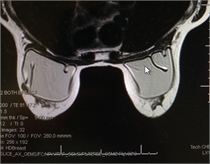 The MRI image shown here is from a patient with Grade IV capsular contracture. Note the folding and deformity of the implant, which can be seen with severe contracture. In general, breast implants should appear smooth and rounded on imaging—not folded or distorted.
Baker Grading Scale
The severity of capsular contracture is commonly described using the Baker Grading Scale:
- Baker Grade I: Breast is soft and appears natural
- Baker Grade II: Breast is firm but appears natural
- Baker Grade III: Breast is firm and appears distorted
- Baker Grade IV: Breast is firm, appears distorted, and may be painful
FAQ
What causes capsular contracture?
The exact cause is not fully understood. Several factors may contribute, including inflammation and low-grade bacterial contamination (biofilm). Certain surgical techniques are used to reduce risk, such as minimizing implant contact with the skin during placement.
What are the signs and symptoms of capsular contracture?
Capsular contracture can cause the breast to feel firmer than expected and may lead to a change in shape, implant position, or visible distortion. In more severe cases, patients may notice tightness or discomfort. If you notice progressive firmness or a change in appearance, it’s worth being evaluated.
How is breast implant capsular contracture treated?
Treatment depends on severity (Baker grade), implant position, and your goals. Options may include capsulotomy (releasing the capsule) or capsulectomy (removing part or all of the capsule), often combined with implant exchange and/or a plane change (for example, moving the implant from above the muscle to below the muscle). In select cases, Dr. Hirsch may use a supportive biologic material such as AlloDerm or Strattice to reinforce the pocket and improve tissue support. If you’re experiencing implant firmness, distortion, or pain, you can learn more about revision approaches on our Breast Implant Revision page.
Can capsular contracture come back after treatment?
It can recur in some patients, especially if there are ongoing risk factors. The surgical approach is often tailored to reduce recurrence risk (for example, addressing the capsule, implant type/position, and pocket support). Your surgeon can explain the likelihood of recurrence based on your history and anatomy.
When should I see a plastic surgeon about possible capsular contracture?
You should schedule an evaluation if you notice increasing firmness, visible distortion, discomfort, or a change in implant position. Early assessment is helpful because the best treatment plan depends on what’s causing the change and how advanced it is.
Call for a consultation
Schedule online today »